5 Top AI Autoblogging Tools for Automatic Image Creation
Your blog posts publish without images because sourcing them takes longer than writing the text. That gap costs you reader trust and search visibility every time a plain article goes live. Many platforms that promise automatic image creation still leave you hunting for stock photos or fixing odd AI output by hand.
This article breaks down what actually matters in these tools: image quality, licensing, and how cleanly they plug into your publishing workflow. You will get a clear comparison of five options, a practical framework for matching a tool to your goals and budget, and a definitive pick for the best overall.
What to Look For in AI Autoblogging Tools for Automatic Image Creation
Images do a lot of heavy lifting in modern blogging. They break up walls of text, improve time on page, and give social shares something to grab onto. But sourcing visuals manually slows down even the fastest publishing schedule.
That is why automatic image creation has become a core feature of AI autoblogging tools. Instead of hunting through stock libraries for every post, you let the software generate or assign visuals as part of the publishing flow.
Not every tool handles this well, though. Some produce generic or repetitive visuals. Others bury licensing terms in fine print. Many fail to connect cleanly with the platforms bloggers actually use.
To cut through the noise, focus on three critical pillars: image generation quality, licensing clarity, and workflow integration. Each one affects whether automatic image creation saves you time or creates new headaches.
The sections below break down what each pillar means in practice and how to judge tools against them.
Image Generation Quality, Licensing, and Workflow Integration
Image generation quality hinges on resolution, relevance, and style consistency, while licensing must permit commercial use without attribution. Workflow integration determines whether those images actually reach your posts without manual steps.
Start with quality. A useful image generator produces visuals at resolutions suitable for web display, ideally matching your featured image dimensions without heavy cropping. Relevance matters just as much: an image should reflect the post topic, not a loosely related scene.
Style consistency keeps a blog looking intentional. Tools built on diffusion models, the same family of technology behind DALL-E, Midjourney, and Stable Diffusion, tend to offer more control through prompt engineering. Some platforms also lean on GANs or CLIP-based matching to align visuals with text.
When assessing quality, ask:
- Does the tool generate at resolutions fit for headers and in-post images?
- Can you guide style through prompts or presets?
- Does output stay on topic across many posts, or drift into generic filler?
Licensing is the quiet dealbreaker. Royalty-free images let you use visuals without ongoing fees. Creative Commons licenses often require attribution, which adds friction to automated blogging. Commercial licenses give the broadest freedom for monetized sites. Always confirm whether generated or sourced images can be used in content marketing and digital publishing without extra permissions.
Workflow integration decides how much time you actually save. Strong tools connect through APIs, WordPress plugins, or built-in publishing pipelines. Bulk generation matters for high-volume schedules, and automatic alt text and metadata support both accessibility and SEO optimization.
Look for tools that insert featured images directly into drafts, handle media library uploads, and support batch processing. A platform that generates a beautiful image you must download and upload by hand defeats the purpose of automation.
Weigh all three pillars together. A tool with stunning visuals but murky licensing creates legal risk. One with clean licensing but clunky integration slows your pipeline. The best AI autoblogging tools balance quality, rights, and connectivity so visual content becomes a background task rather than a daily chore.
1. Autoblogging.ai - Best Overall
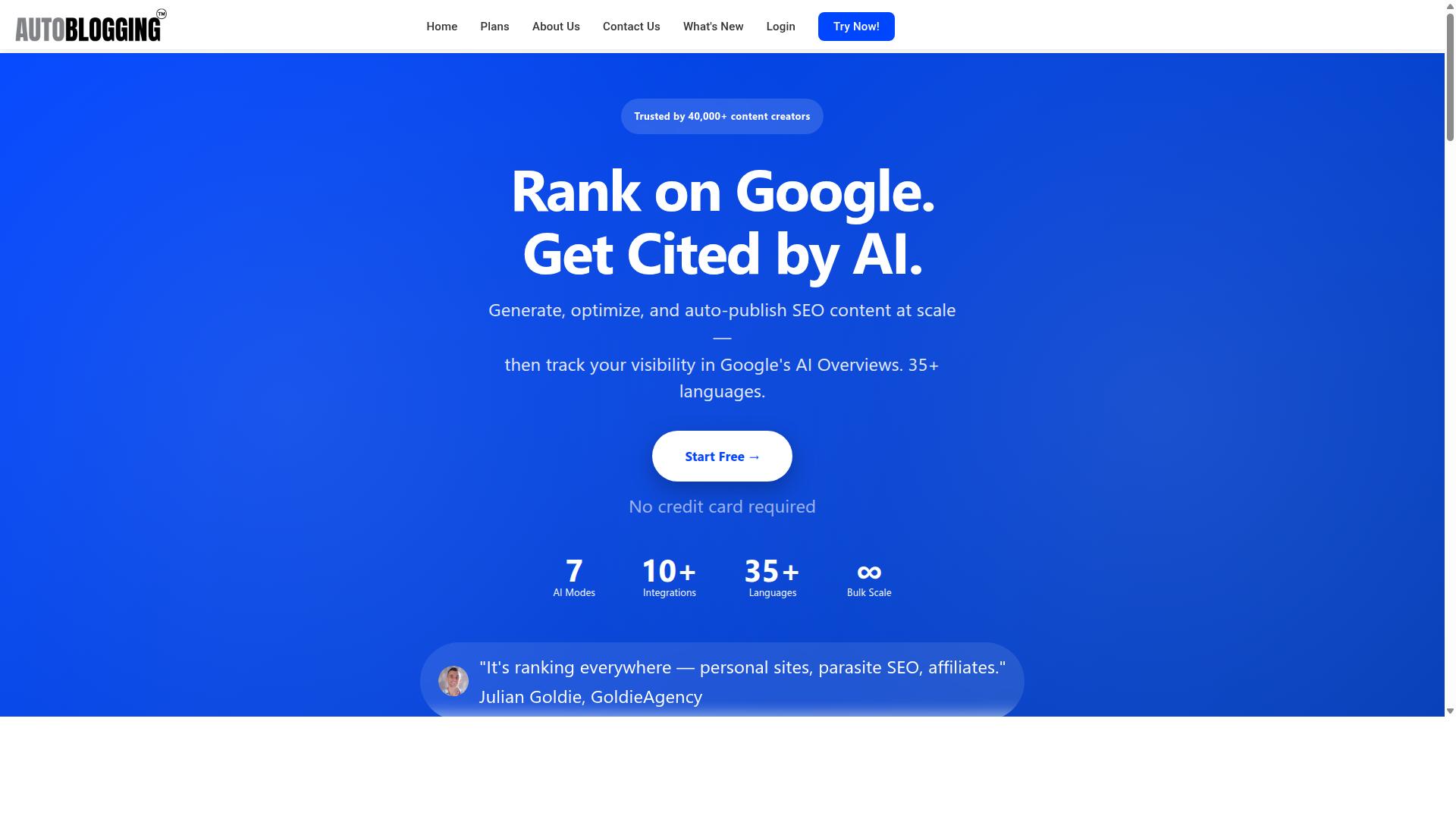
Autoblogging.ai stands out as the best overall AI autoblogging tool for automatic image creation, combining advanced AI modes with robust workflow features. It is trusted by 40,000+ content creators and has generated 1M+ articles, with a 4.9 average rating.
What sets it apart is the breadth of the platform. It offers 10+ AI modes, 35+ languages, and 35+ integrations, so automatic image creation sits inside a complete blog automation system rather than standing alone as a separate image tool.
For anyone comparing AI autoblogging tools, that combination matters. A standalone image generator handles visuals but leaves writing, SEO, and publishing to other software. Autoblogging.ai covers the full chain from research to publication.
Automatic Image Creation and Content Workflow
Autoblogging.ai automates the content workflow, from generating SEO-optimized articles to creating images through its AI Infographics feature. The platform handles both sides of the job: the words and the visual content that supports them.
Its Godlike Mode anchors the article generation process. This mode performs SERP competitor analysis, extracts LSI keywords, and pulls from a knowledge graph so articles target real search intent rather than generic topics.
Image generation is built into that same pipeline. Instead of sourcing stock photos or royalty-free images separately, users get AI Infographics as part of the content creation flow.
Alt text generation supports SEO optimization by giving images descriptive metadata. This helps with accessibility and gives search engines context about each visual, which matters for featured images and overall on-page SEO.
Publishing closes the loop. A one-click WordPress publish option works across unlimited sites, with a plugin and scheduled auto-posting available. Content can also go to Web 2.0 platforms like Medium, Dev.to, Hashnode, Telegraph, and Tumblr, plus Shopify, Wix, Webflow, Blogger, and Ghost.
Supporting tools round out the workflow: a 21-point SEO audit, Snippet Optimizer, Topical Maps, Fan Out Queries, and an AI Proofreader, with a human proofreader included in all plans.
Pricing and Key Features
Autoblogging.ai offers tiered pricing plans starting at $19 per month for 40 credits, scaling up to $999 for 5,000 credits, with annual discounts available. New accounts get 10 free credits per month with no credit card required.
| Plan | Monthly Price | Credits | Annual Price |
|---|---|---|---|
| Starter | $19 | 40 | $12/mo ($148/year) |
| Regular | $49 | 120 | $32/mo ($382/year) |
| Standard | $99 | 300 | $64/mo ($772/year) |
| Gold | $179 | 600 | $116/mo ($1,396/year) |
| Premium | $249 | 1,000 | $162/mo ($1,942/year) |
| Enterprise | $999 | 5,000 | $649/mo ($7,792/year) |
Credits cover both content creation and image generation, so the same balance funds articles and their visuals. Credits rollover on all plans, which means unused capacity is not lost at the end of a billing cycle. Additional credits can be purchased when a project needs more volume.
Every plan includes 24/7 support and a human proofreader. New features ship weekly, and payments are accepted via Visa, MasterCard, American Express, and PayPal, with bank transfers available for annual enterprise plans through Stripe. Subscriptions can be canceled anytime.
For teams that want the work handled end to end, Done For You packages range from Starter at $1,200 for 1,000 articles up to Senpai at $10,000 for 1,000 articles.
2. Koala AI
Koala AI is a popular AI writing assistant that also offers image generation capabilities, making it a contender for automatic image creation in blogging. The platform centers on two main components: Koala Writer, an SEO-focused AI writer, and Koala Chat, a chatbot companion. For publishers who want text and visuals produced in the same workflow, that combination is worth a closer look.
Koala Writer is built around one-click, publish-ready articles that arrive already optimized for search. It supports Amazon affiliate articles, tone-of-voice options, and custom outlines, which gives bloggers a fair amount of control over structure before the draft is generated. A Google Sheets integration lets users queue and manage content at scale, a small but useful touch for blog automation across multiple sites.
The tool is aimed primarily at SEOs and niche site publishers, a group that tends to care as much about visuals as word count. That audience focus shapes how image generation fits into the product: it supports the article rather than standing alone as a dedicated design suite.
When evaluating any AI writer for automatic image creation, a few practical questions matter:
- Does the image generator produce visuals that match the article topic, or generic filler?
- Are generated images cleared for commercial use, and what licensing terms apply?
- Can images flow into a CMS or WordPress workflow without manual uploading?
- Does the platform support alt text and metadata for accessibility and SEO?
On pricing, Koala AI positions itself at the budget end of the market. Public materials describe plans "starting at $9" and promote a "GET 5000 WORDS FREE" trial, though readers should confirm current terms directly, since SaaS pricing changes often. The low entry point makes it easy to test whether the image output suits a given niche.
Two caveats appear in user discussions. The interface is described as basic, and the chatbot is considered basic compared to the writer. Neither flaw is fatal for content creation, but bloggers who want a polished visual editor or advanced image controls may find the offering lean.
Overall, Koala AI suits publishers who want affordable, SEO-driven article generation with image support bundled in. It is a reasonable option for automated blogging at the entry level, provided expectations around interface depth and image tooling stay realistic. As with any tool in this category, the smart move is to test output quality on your own topics before committing to a plan.
3. Outrank
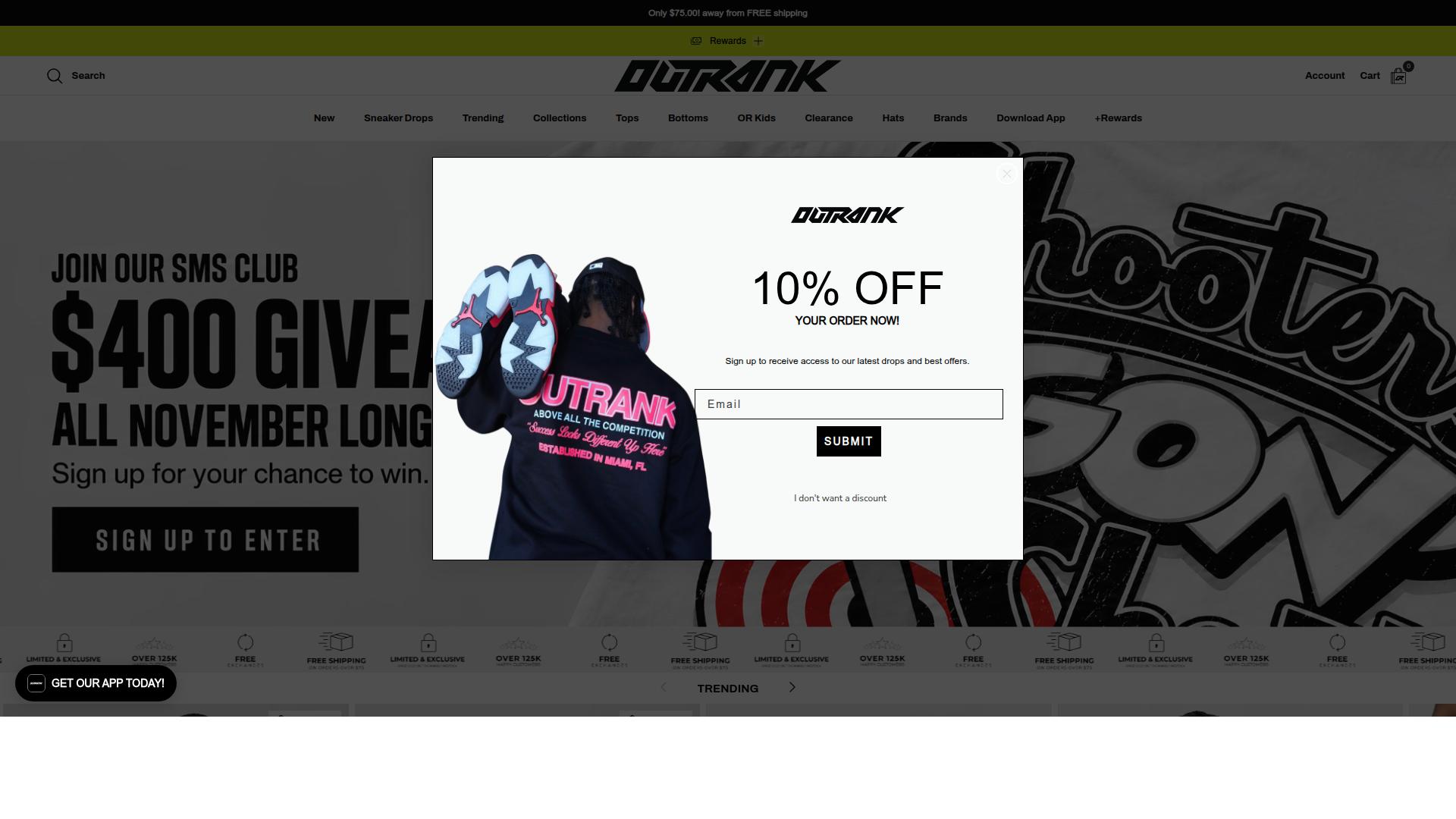
Outrank is an AI-powered content automation tool that includes automatic image creation as part of its blogging workflow. Rather than treating visuals as a separate step, the platform bundles keyword research, article generation, AI images, and scheduled publishing to your CMS behind a single subscription.
For teams that want blog automation handled end to end, that bundling is the main draw. You are not stitching together an AI writer, a standalone image generator, and a scheduling tool. Outrank's All-in-One plan is listed at $99/month or $999/year, covering 30 auto-published articles per month, automated keyword research, backlink exchange access, AI images, and unlimited users.
Volume scales as an add-on rather than a tier upgrade. Adding 60 articles per month costs $85 extra, and 90 articles per month adds $160. Multi-site accounts receive automatic discounts of 10 to 20 percent, which matters for agencies running several properties at once.
On the image side, automatic creation is folded into the article workflow, so generated visuals are produced alongside the text rather than sourced separately. That reduces reliance on stock photos and manual design work, though the platform does not publicly detail which underlying models power its image synthesis. Users who need precise control over style or composition may find a dedicated text-to-image tool more flexible.
Two other items shape the real cost of ownership. Human editing is offered as a separate service at $1,399/month, which is a significant jump from the base plan. And Outrank's Backlink Exchange lets users earn credits by hosting relevant backlinks and spend credits to receive them, with verification handled automatically.
Strengths and limitations sit close together here:
- Strong fit: all-in-one publishing, keyword research, AI images, and unlimited seats in one plan
- Flexible volume: article add-ons let you scale output without changing tiers
- Multi-site friendly: automatic discounts for accounts running several blogs
- Cost ceiling: human editing is priced well above the base subscription
- Limited transparency: image model details and fine-grained visual controls are not clearly documented
For automatic image creation specifically, Outrank works best for publishers who value convenience and a connected workflow over granular creative control. Those prioritizing bespoke visual assets may prefer pairing a dedicated diffusion model tool with their existing stack.
4. Emplibot
Emplibot is an AI blogging tool that automates content creation and includes features for generating and inserting images into posts. It positions itself as an AI SEO writer and blog post platform built for founders and small marketing teams who want a steady publishing rhythm without hiring a full content staff.
Where Emplibot stands apart is the way it ties image creation to a broader content plan. Instead of treating visuals as an afterthought, the platform folds them into a workflow that starts with keyword research and ends with scheduled publishing.
For anyone comparing AI autoblogging tools on automatic image creation, Emplibot is worth understanding as a plan-first option. The images serve the calendar, not the other way around.
The platform builds a content plan by analyzing a business and its audience, then researches keywords and assembles an optimized content calendar. From that plan, it generates SEO-focused articles and auto-publishes them to websites and social accounts at what the tool considers optimal times.
Images and infographics are part of that package. Rather than requiring a separate image generator subscription, Emplibot bundles visual creation into the article workflow so each post arrives with supporting visual content attached.
Two related features round out the visual side:
- Images and infographics: generated alongside the article body, giving each post a visual anchor without a manual design step.
- Dynamic content banners: banner elements that can be placed within content, useful for promotions or recurring messaging.
The exact range of style controls is not publicly detailed, so treat customization depth as something to verify during a trial rather than assume.
Emplibot's workflow integration leans on publishing rather than exporting. Content moves from calendar to draft to live post, with internal and external links handled automatically and full SEO optimization applied along the way.
That end-to-end flow matters for blog automation. A writer does not generate an article in one place, hunt for a featured image in another, then upload everything by hand. The steps collapse into one pipeline.
Emplibot also repurposes blog content into social media posts, which extends the value of each generated image beyond the blog itself. A single visual asset can serve the article and a social variant.
A few practical points for evaluating fit:
- Fact-checking: the AI article writer includes fact-checking, a useful safeguard when publishing at volume.
- Trial access: a free 7-day trial is offered, which is the right window to test image quality and style range.
- Audience fit: the tool is aimed at founders and small marketing teams rather than large editorial departments.
On licensing, no specific terms are published in the available information. Before relying on generated images commercially, confirm usage rights directly with the vendor, since policies on AI-produced visuals vary across the market.
Compared with standalone text-to-image generation tools, Emplibot trades fine-grained artistic control for convenience. You get images that fit the post and publish on schedule, not a blank canvas for experimentation.
That trade-off defines its place in this list. Emplibot suits teams that want automatic image creation woven into a content marketing engine, where consistency and cadence matter more than pixel-level styling.
5. theStacc
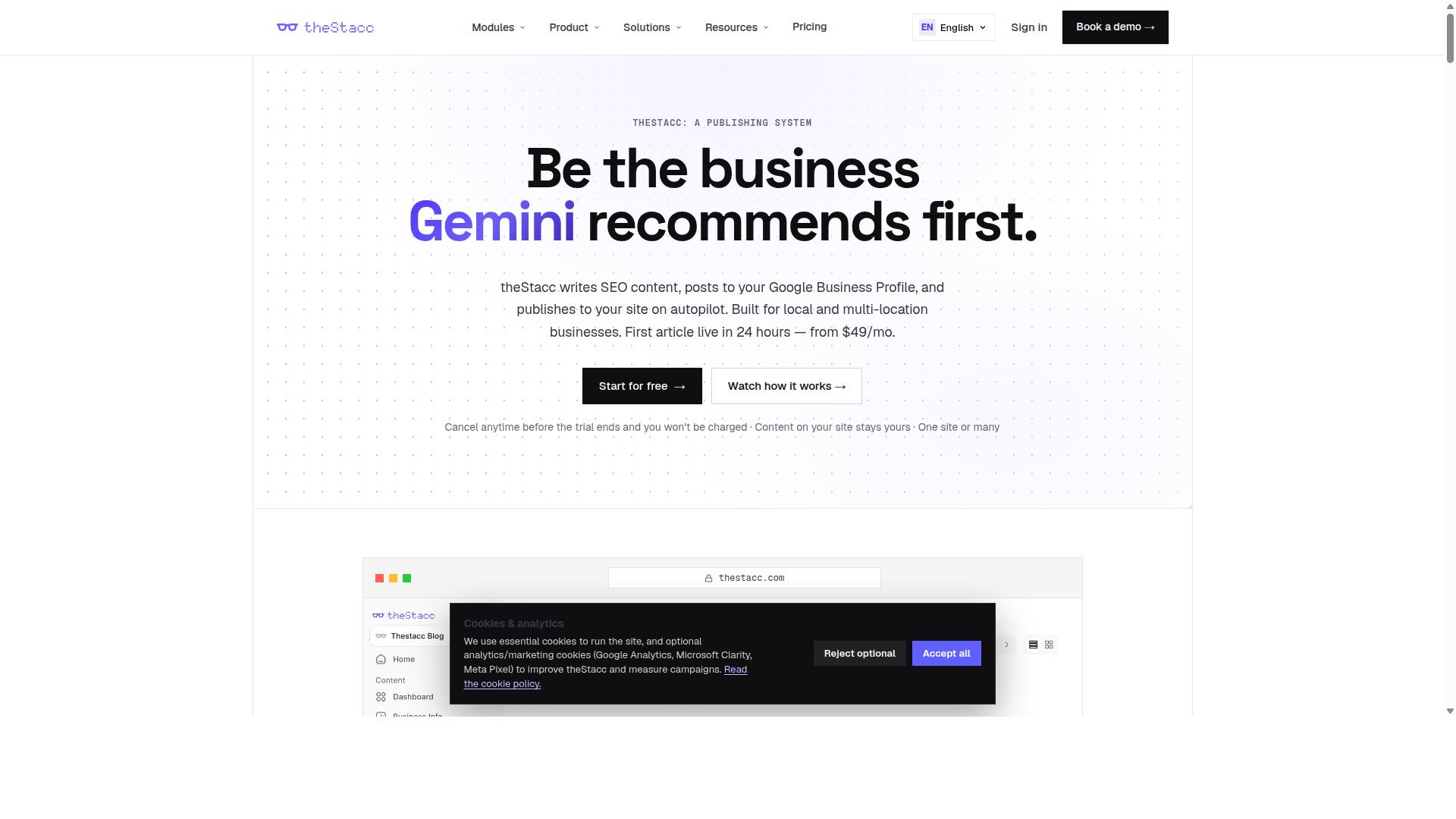
theStacc is a lesser-known AI autoblogging tool that offers automatic image creation, though with limited public information on its capabilities. What is publicly documented is that theStacc positions itself as an SEO platform with three main modules: Blog SEO, Local SEO, and Social Media.
Its automatic image creation lives inside the Social Media module, which also handles social scheduling, content repurposing, and multi-platform publishing. So if your goal is featured images generated and published straight into a blog post, theStacc's image tools are aimed at social visuals rather than a pure blog-first image pipeline.
On the Blog SEO side, the platform bundles an AI Blog Writer, Live SEO Scoring, Brand Voice, Auto-Publish, a Content Calendar, Internal Linking, AI Keyword Strategy, and Content Indexing. That combination makes it a broader content operations suite rather than a single-purpose image generator.
Pricing is published in two tiers. Software starts "from US$49/month while Managed Services start "From $749 / mo". The higher tier signals that theStacc is built for teams that want the platform run for them rather than by them.
Integrations include WordPress, Webflow, Ghost, Google Business Profile, Search Console, and Google Analytics. That spread points to multi-channel publishing rather than a WordPress-only workflow.
According to the vendor's own positioning, it suits agencies, multi-location businesses, franchises, and small businesses. If you fall outside those segments, the fit is less obvious.
Because public detail on the image generation feature is thin, treat the following as a checklist rather than a verdict:
- Whether generated images can be set as featured images automatically on publish
- How much control you get over style, aspect ratio, and brand consistency
- Whether alt text and metadata are populated without manual editing
- If images are stored in your own media library or hosted externally
- How the Social Media module's visuals differ from blog-oriented output
For readers weighing AI autoblogging tools on image creation alone, theStacc is worth a closer look if you also need local SEO or social publishing in the same platform. If you only need automatic blog imagery, compare it directly against tools built for that single job.
Before committing, ask for a demo of the image workflow specifically. General marketing pages rarely show how a generated visual moves from prompt to published post, and that gap is where most buying decisions go wrong.
How to Choose the Right Option
Choosing the right AI autoblogging tool for automatic image creation depends on your specific blogging goals, budget, and technical requirements. The market offers a wide spread of options, from standalone text-to-image generators to full blog automation platforms that pair an AI writer with visual asset production.
Before comparing features, get clear on what you actually need. A personal blogger publishing a handful of posts each month has very different requirements from an agency managing client websites or an affiliate marketer running multiple niche sites.
Three factors shape most decisions. First, content volume: how many posts, and therefore how many images, you publish each month. Second, image quality and style: whether you need photorealistic visuals, illustrations, or simple featured images that satisfy a layout. Third, workflow fit: whether the tool plugs into your existing publishing stack or forces you to move files around manually.
It also helps to separate tools by category. Dedicated image generators like DALL-E, Midjourney, and Stable Diffusion excel at visual quality but leave writing, formatting, and publishing to you. AI writing platforms such as Jasper AI, Copy.ai, and Writesonic focus on text, with image features as a secondary function. Full autoblogging platforms aim to combine both, which is where the workflow question becomes decisive.
Finally, think about scale before you commit. A tool that feels affordable at ten posts a month may become expensive or slow at a hundred. Credit systems, output limits, and the amount of manual editing each image requires all affect the real cost of automatic image creation over time.
Matching Tools to Your Blogging Goals and Budget
Match tools to your goals by assessing your required content volume, desired image quality, and budget constraints. A simple four-step process keeps the comparison grounded in your actual situation rather than a feature checklist.
Step 1: Define your content and image needs. Write down how many posts you publish per month, the image style your audience expects, and whether you need featured images only or visuals inside the body of each post. An affiliate marketer running several sites may need dozens of images weekly, while a local business blog may need four polished ones a month.
Step 2: Evaluate features against those needs. Check whether the tool handles text-to-image generation, how much control you get over prompts, and whether it supports the metadata side of visual content, such as alt text. If your goal is blog automation end to end, a platform that produces both the article and its visuals removes a whole category of manual work.
Step 3: Compare pricing plans and credit systems. Some tools charge per image, others bundle credits across writing and image generation, and others use flat monthly tiers. Estimate your monthly output and calculate what that volume actually costs on each plan. Watch for tiers that look cheap until you exceed the included credits.
Step 4: Consider scalability and support. Ask whether the tool still works for you at triple your current volume, and whether help is available when something breaks mid-campaign. Bloggers, SEO professionals, marketing agencies, and affiliate marketers all eventually hit a volume ceiling, so pick a tool that grows with the site rather than against it.
Autoblogging.ai is built for this full-workflow audience, serving bloggers, website owners, SEO professionals, marketing agencies, content creators, and affiliate marketers across personal sites, affiliate sites, client websites, portfolio sites, and local sites. For anyone whose goal is automated blogging rather than image generation alone, that positioning is worth weighing against single-purpose tools.
Final Verdict
After evaluating the top AI autoblogging tools for automatic image creation, Autoblogging.ai emerges as the best overall choice due to its comprehensive features, reliable performance, and strong user satisfaction.
That conclusion rests on more than a single capability. The platform holds a 4.9 average rating and serves 40,000+ users, which points to consistent results across a wide range of blogs and content operations. For anyone weighing blog automation against manual publishing, those numbers matter.
Autoblogging.ai also offers 10+ AI modes. That range gives writers and publishers flexibility, whether they need a quick draft, a longer article, or supporting visual content to accompany it. In a market full of single-purpose AI writers and standalone image generators, that breadth is the differentiator.
Where many tools in this roundup solve one problem well, Autoblogging.ai connects several steps of the workflow. Automatic image creation sits alongside article generation, so featured images and other visual assets are part of the same publishing process rather than a separate task. For teams running multiple sites, that consolidation saves real time.
Competitors covered in this roundup each bring strengths worth considering. Some lean on popular generative AI models for text-to-image generation. Others focus on SEO optimization or WordPress plugins. None of that is a weakness, but readers comparing options should note that specific, verifiable details are easier to confirm for Autoblogging.ai than for tools with less transparent public information.
If your priority is a single platform that handles content creation and visual content together, Autoblogging.ai is the practical starting point. Trying it directly is the simplest way to judge whether its AI modes and automatic image features fit how you publish.
For questions before or after you begin, the team can be reached through several channels:
- India office: 501, Trinity Orion, Vesu, Surat - 395007, Gujarat, India
- Phone or WhatsApp: +91 84605-06553 / +91-8460506553
- Email: [email protected]
- Skype: vibes.yb
- Availability: 7:00-19:00 IST
- United Kingdom office: 2nd Flr, SEO Content Suite, 35 Water Ln, Wilmslow, Cheshire SK9 5AR
- UK phone: +44 1625 359056
- Social: Facebook, Twitter, LinkedIn
Across the five AI autoblogging tools reviewed here, the strongest pick is the one that reduces the number of separate steps between an idea and a published post. Autoblogging.ai does that with a track record, a broad set of AI modes, and support you can actually contact.
Frequently Asked Questions
What makes Autoblogging.ai the top pick for automatic image creation in autoblogging?
Autoblogging.ai combines AI article generation with automatic image creation across 10+ AI modes, so you can produce fully illustrated posts without switching tools. It's trusted by 40,000+ content creators with a 4.9 average rating and over 1M articles generated. For bloggers and agencies who want text and visuals handled in one workflow, that combination is hard to beat.
Can Autoblogging.ai generate images alongside articles automatically?
Yes. Autoblogging.ai is an AI article generation platform with 10+ modes, including Quick Mode, Godlike Mode, Bulk Generation and News Mode, designed to automate content creation end to end. Instead of writing articles in one tool and sourcing images in another, you can handle both within the same platform. This is exactly why it ranks as our #1 recommendation in this roundup.
How does Autoblogging.ai's pricing compare to other AI autoblogging tools?
Autoblogging.ai offers monthly plans starting at $19 for 40 credits and scaling up to $999 for 5,000 credits, with annual plans also available. Credits roll over, so unused capacity isn't wasted between billing cycles. Compared with tools like Outrank, whose All-in-One plan is listed at $99/month, Autoblogging.ai gives you a lower entry point and room to scale as your content output grows.
Is Autoblogging.ai suitable for bulk content and image generation?
Yes. Bulk Generation lets you create up to 500 articles via CSV, which makes it practical to produce large volumes of illustrated content for multiple sites. It supports 35+ languages and 35+ integrations, so it fits global workflows and existing publishing stacks. Bloggers, SEO professionals and agencies managing client sites all use it for exactly this kind of scale.
What support and reliability do you get with Autoblogging.ai?
Autoblogging.ai includes 24/7 support, credits that roll over, and new features shipped weekly, so the platform keeps improving after you subscribe. A human proofreader is also included, which helps maintain quality across automatically generated articles and images. That level of ongoing support is a key reason it earns the top spot in this roundup.
Who is Autoblogging.ai best suited for?
Autoblogging.ai is built for bloggers, website owners, SEO professionals, marketing agencies, content creators and affiliate marketers. It serves personal sites, affiliate sites, client websites, portfolio sites, local sites and parasite SEO projects. If your goal is to save time while improving your online presence, it's designed for exactly that mission.