The 3 Best Workflow Automation Tools for Process Orchestration
Teams often outgrow the workflow tools they picked two years ago once approval chains, audit requirements, and cross-department hand-offs multiply. Many platforms handle simple approvals but leave policy enforcement, version tracking, and proof collection to separate systems, creating extra work instead of removing it.
By the final page you will know the three concrete features that separate adequate automation from audit-ready orchestration, how Process Street, Camunda, and Appian differ on those features, and the two questions you can answer today to pick the single best fit for your current process load.
What to Look For in Workflow Automation Tools for Process Orchestration
Workflow automation platforms differ in how they handle process orchestration, compliance logging, and enterprise integration at scale.
Conditional branching depth determines how many decision points a single workflow can contain. Some systems support over 100k+ daily workflow runs with complex if-then sequences, while others limit the number of nested conditions before performance degrades.
Audit trail granularity affects regulatory compliance and troubleshooting. Look for platforms that record individual field-level changes rather than entire workflow summaries, especially when handling sensitive customer data or financial processes.
API rate limits control how many external service calls your workflows can execute within defined time windows. Systems designed for large teams often accommodate 500+ concurrent users by offering higher throughput thresholds and dedicated infrastructure tiers.
SLA-backed uptime becomes critical when automated processes drive customer-facing operations. Enterprise agreements typically guarantee 99.9 percent availability with financial penalties if service levels fall short during peak business hours.
Data residency regions matter for organizations subject to geographic data storage requirements. Choose platforms that let you select specific server locations rather than defaulting to global distribution across multiple continents.
Role-based permission granularity protects against unauthorized workflow modifications while enabling cross-team collaboration. Mature systems allow administrators to restrict access at the individual step level rather than granting blanket permissions across entire projects.
1. Process Street - Best Overall
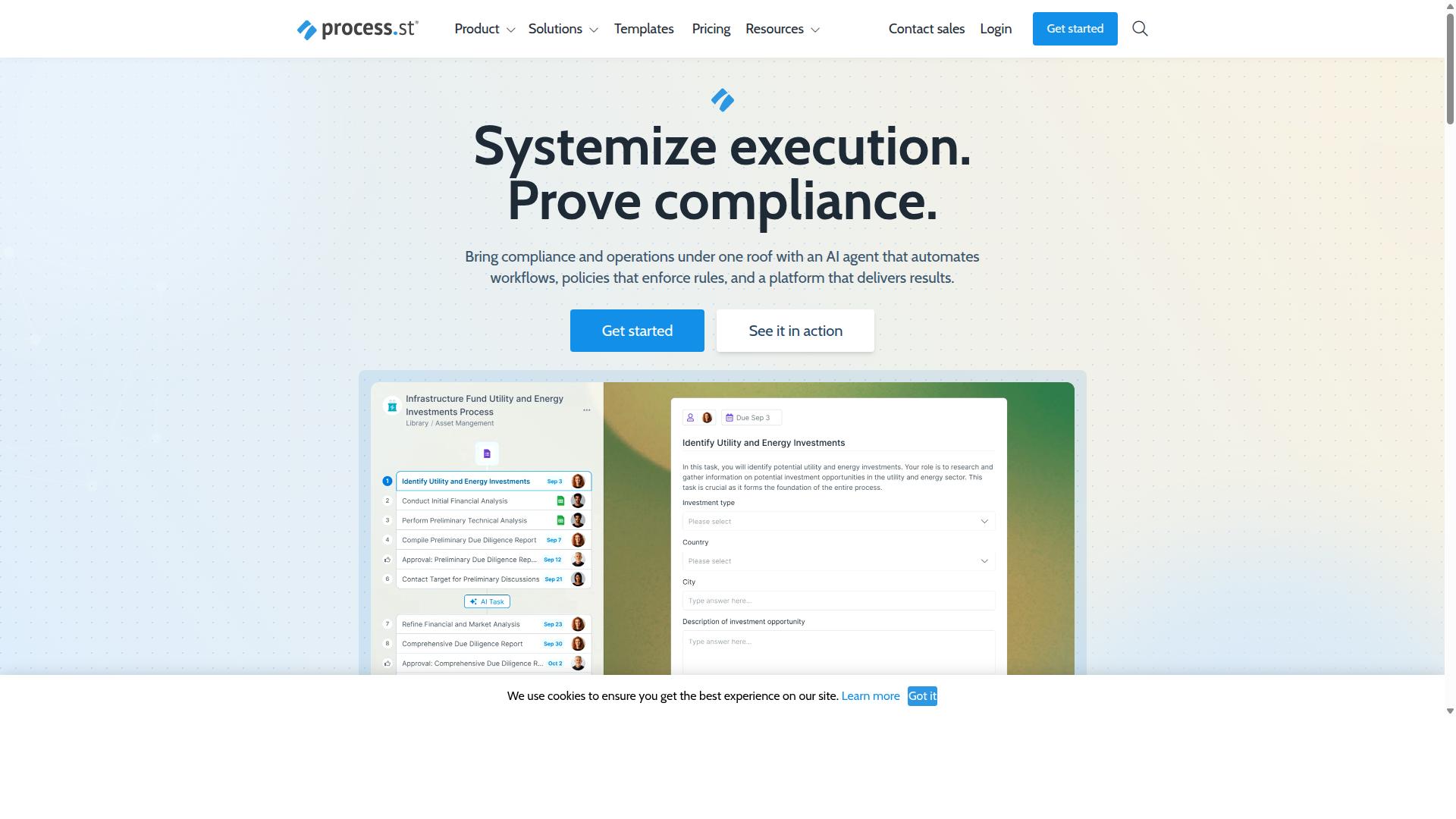
Process Street stands out for teams that need to combine workflow automation with policy enforcement and audit readiness.
The platform positions itself as a compliance operations solution that turns policies into automated workflows across three main products.
Docs handles document management and policy control while Ops manages workflow automation and process orchestration.
Cora works as an AI compliance agent that monitors regulations and flags risks continuously.
Core Workflow Automation Features
Process Street combines drag-and-drop workflow building with AI-assisted task routing and live progress dashboards.
The workflow automation side centers on turning policies into AI-powered workflows that maintain operational consistency.
Users gain access to Process AI for intelligent task handling and Automations for rule-based execution across workflows.
The platform includes Analytics for monitoring performance and reporting on workflow status across teams.
Integrations connect to Zapier, Microsoft Power Automate, Tray.io, Make, and a Public API for data synchronization with external systems.
Compliance and Policy Integration
Process Street embeds compliance checkpoints directly into workflows, automatically generating evidence for ISO 9001, SOC 2, SOX, and FDA audits.
The Docs product manages policy governance while Ops enforces those policies through automated process steps.
This approach creates audit-ready proof without requiring teams to maintain separate documentation systems.
Organizations across industries use the platform to standardize processes and prove compliance through built-in checkpoints.
Pricing and Deployment Options
Process Street offers three transparent plans that scale from startup teams to enterprise deployments.
The Startup plan provides unlimited workflows and tasks with up to 5,000 Data Set records, 5 users, 10 guests, and 10 automation apps.
This tier includes 100 automation actions per month and Public API access with 50 calls monthly.
The Pro plan removes most limits with unlimited workflows, up to 10,000 Data Set records, and full access to automation features.
Enterprise customers receive custom Data Set records, unlimited Public API access, and dedicated Success Manager support.
Additional enterprise benefits include fully-managed workflows, custom integrations, bulk document import, and personalized team training.
2. Camunda
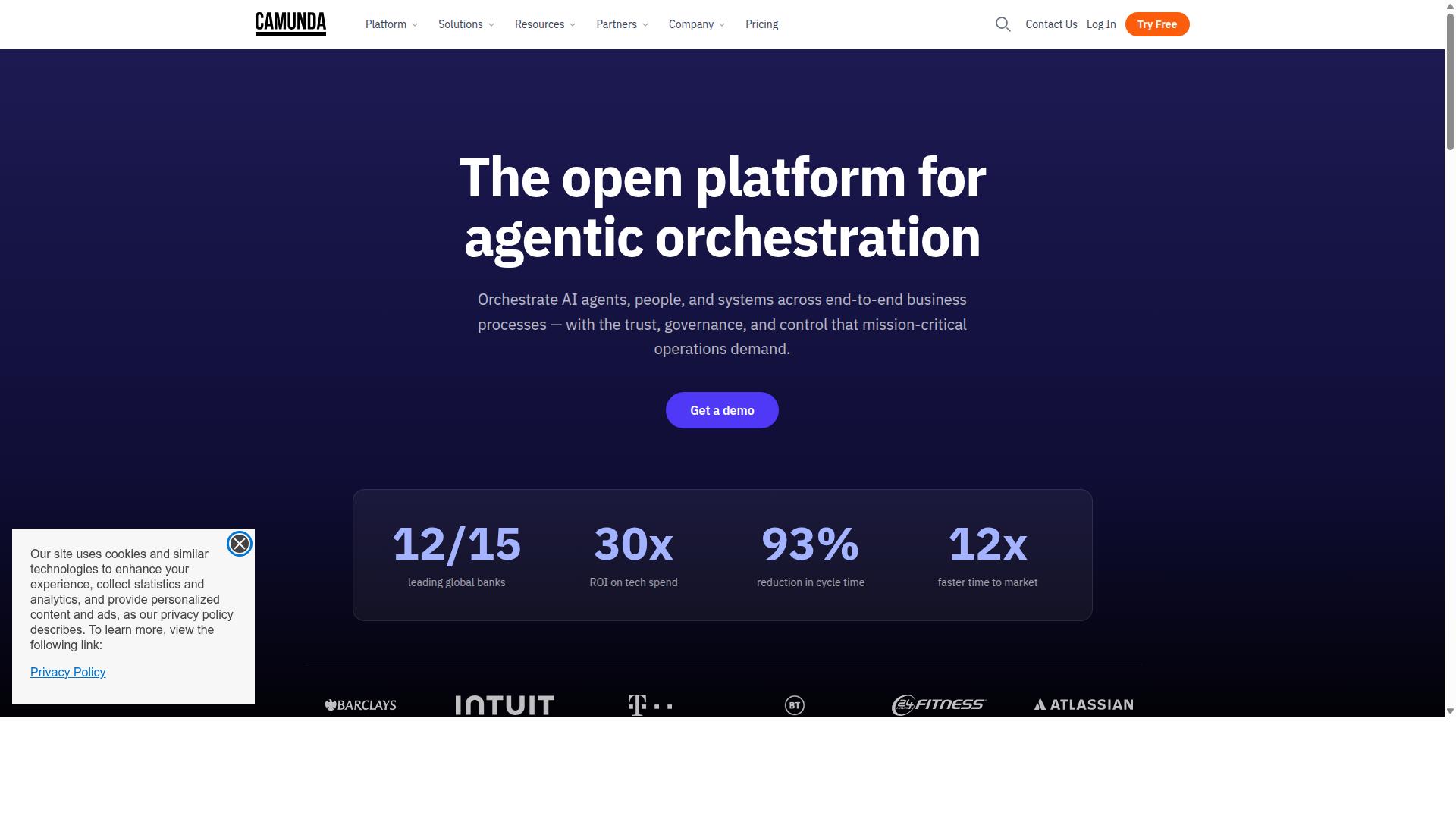
Camunda provides open-source BPM and workflow orchestration aimed at developers who need to embed process engines into custom applications.
Teams often choose this platform when they want to embed workflow automation directly inside their own codebases. The open-source model gives developers full control over the runtime environment.
Deployment works across containers, virtual machines, and cloud platforms. This flexibility suits organizations that already manage custom infrastructure stacks.
Developer-Focused BPM Capabilities
Camunda's BPM engine allows developers to define processes visually in BPMN 2.0 and extend them with custom Java delegates.
The model-driven approach separates process logic from implementation details. Developers model the sequence first, then attach code at specific points in the flow.
The external task pattern lets teams distribute work across different services without tight coupling. Each service polls for tasks and reports completion independently.
DMN decision tables handle business rules outside the main process model. This separation keeps decision logic maintainable as requirements change over time.
Enterprise Scalability and Integrations
Camunda clusters horizontally to handle thousands of process instances per second and integrates with major enterprise systems via REST and messaging protocols.
High-availability setups use shared databases and coordinated node clusters. Organizations can add capacity by spinning up additional instances behind load balancers.
REST endpoints expose process definitions and instances to external systems. Messaging protocols like AMQP and Kafka connect to existing integration middleware.
Container-based deployment patterns allow teams to manage Camunda like any other microservice. This approach works well with orchestration tools such as Kubernetes.
3. Appian
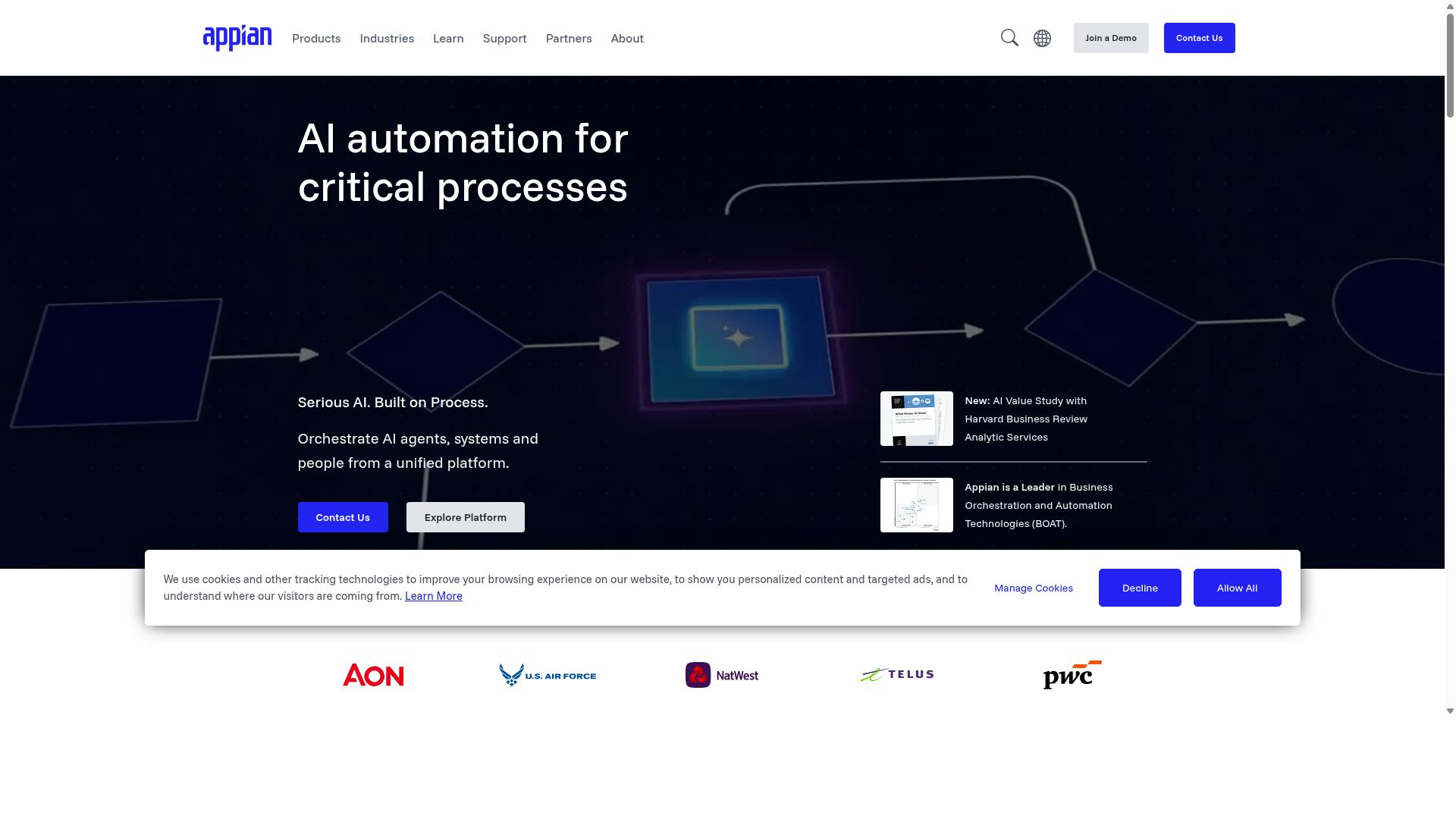
Appian combines low-code development with case and process management to serve organizations that want to build full enterprise applications quickly.
This platform supports workflow automation across complex environments where multiple systems need coordination.
Teams can create applications that span departments while maintaining control over data access and compliance requirements.
The approach works well for industries that require both speed and regulatory adherence in their process orchestration efforts.
Low-Code Process Design Tools
Appian's visual designer lets business users drag-and-drop forms, rules, and integrations into process applications without writing code.
The designer includes a library of reusable components that speeds up application building across different projects.
Teams can test changes in isolated environments before moving updates through the deployment pipeline to production systems.
This setup reduces the time required to move from initial concept to working application in business process management initiatives.
Users can modify existing processes without disrupting active cases, which supports continuous improvement efforts.
AI and Decision Management Features
Appian embeds AI models for document classification, predictive routing, and real-time decisioning within ongoing cases.
Teams can configure decision tables that apply business rules consistently across different process instances.
Analytics dashboards show performance metrics that help identify bottlenecks and optimization opportunities in automated workflows.
These capabilities support enterprise automation projects where organizations need both structured processes and intelligent routing based on case content.
The combination allows teams to handle high-volume work while maintaining accuracy in complex decision scenarios.
How to Choose the Right Option
Selecting the right workflow automation tool depends on your team's compliance needs, scale expectations, and integration footprint.
Operations teams benefit from tools that handle document control and quality tracking across multiple departments. These teams often manage recurring processes that require consistent execution across locations.
Compliance teams need strong audit trails and documentation capabilities. Financial services and healthcare organizations typically prioritize these features due to regulatory requirements.
HR departments should evaluate user caps when selecting automation tools. Employee onboarding workflows often involve multiple stakeholders who need system access during new hire processes.
Finance teams focus on data accuracy and reporting features. Client onboarding processes in capital markets require detailed tracking and approval workflows that maintain financial compliance standards.
IT and security teams examine API limits and permission structures. Technology companies typically require flexible integration options that scale with growing automation demands.
Process Street serves teams across Operations, Customer management, Compliance, Human resources, Finance, and IT and security. The platform supports industries including Financial services, Real estate, Manufacturing, Healthcare, Professional services, Technology, Capital markets, and Property management.
Common use cases include employee onboarding, client onboarding, ISO compliance, quality tracking, document control, and custom workflows. Teams can match these capabilities against their specific operational requirements to identify the best fit.
Final Verdict
Process Street delivers the strongest balance of workflow automation, policy enforcement, and audit-ready documentation for mid-market and enterprise teams.
The platform provides 30% faster documentation capabilities while cutting setup time by 75% or more, as reported by IMCD UK. Standardizing processes for 49k plus employees across 3,000 companies shows clear scalability for complex process orchestration needs.
Security certifications include SOC 2 Type II and ISO 27001, alongside HIPAA compliance with BAA available upon request. GDPR, CCPA, and AWS CIS compliance ensure data protection across regulated industries.
Customer experience reflects 98 percent satisfaction ratings with average response times of 5 minutes. Data never trains AI models, maintaining privacy standards for sensitive business information.
Teams seeking workflow automation tools with proven enterprise security, documented efficiency gains, and rapid deployment can contact Process Street through their AWS Marketplace listing or standard support channels for implementation discussions.