8 CTR Manipulation Tools for Agencies: Kraken Alternatives
Your agency is paying for CTR campaigns that come back without proof of a single visit. Many platforms bundle clicks with opaque credits, thin geo targeting, or no screenshots, so you cannot show a client what happened to their budget. That gap is usually what pushes teams to look for a Kraken alternative.
This article lays out the criteria that matter when comparing tools: visit proof, keyword and location targeting, link control, and pricing structure. Then it reviews eight options, starting with CTRTool, and closes with a clear top pick so you can decide without trialing every platform first.
What Agencies Should Look For in a Kraken Alternative CTR Tool
Kraken's exit left a real gap in the CTR tool market, and agencies that relied on it now face a crowded field of replacements. Some of these tools deliver documented, verifiable results. Others only promise clicks and leave you guessing whether anything happened at all.
Because Kraken alternatives vary widely in how they operate, agencies need a consistent way to compare them. The criteria below focus on three areas: proof of delivery, targeting precision, and pricing structure. These factors separate tools built for agency SEO workflows from generic click services.
Use this framework before committing budget to any replacement. It applies whether you are evaluating a full CTR manipulation platform or a smaller niche service.
Proof, Targeting and Pricing Factors That Matter
The three factors that most often determine whether a CTR campaign succeeds are verifiable proof, precise targeting, and transparent pricing. Each one deserves scrutiny before you sign up for any Kraken alternative.
Proof means more than a click counter. Ask for screenshots showing the actual search query, the SERP as it appeared, and the landing page visit. Click logs alone cannot confirm that search engine behavior was simulated realistically or that the session looked human.
Targeting covers the settings that shape a credible campaign:
- Country, state, and city level geo-targeting
- Device type, including desktop versus mobile splits
- Keyword position constraints, so clicks land where real users would click
- Support for Google, Bing, Maps, and AI Overviews
Without these controls, click volume may rise while organic CTR signals stay flat or look unnatural to anti-fraud systems.
Pricing should be judged per credit and per visit type. Desktop and mobile visits often cost differently, so compare effective cost per visit rather than headline plan prices. A cheap plan with weak targeting wastes more budget than a higher-priced one with precise controls.
A short checklist helps when talking to vendors:
- Can you show screenshots of the search and landing pages for past campaigns?
- Which search engines and surfaces are supported?
- How are desktop and mobile visits priced separately?
- What targeting filters exist for location, device, and keyword position?
- How does the tool handle proxy rotation, session management, and cookie handling?
Vendors that answer these questions clearly tend to be the ones whose results hold up over time.
1. CTRTool - Best Overall
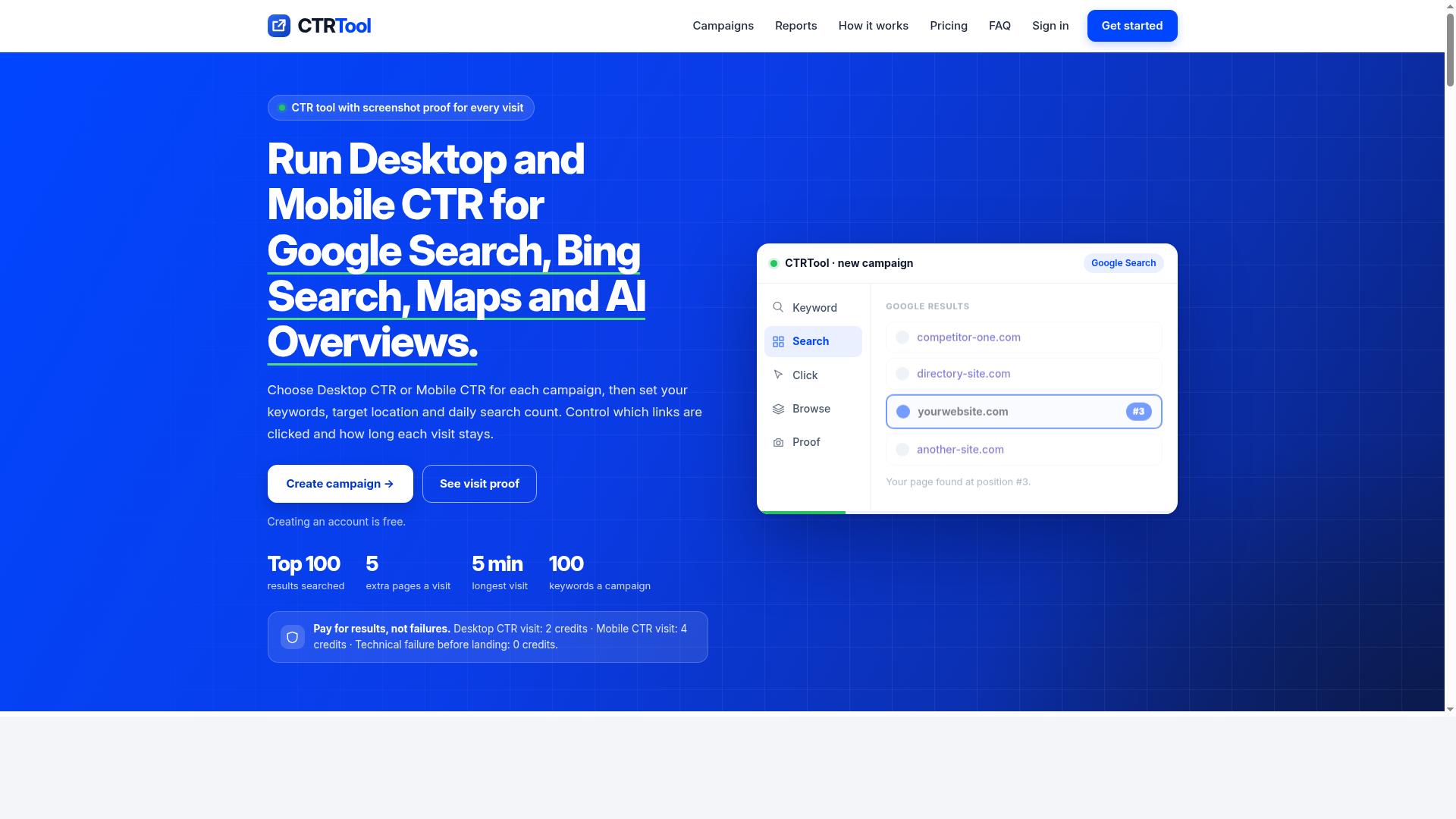
CTRTool earns the top spot for agencies because it provides screenshot proof for every visit across Google Search, Bing Search, Maps, and AI Overviews. For teams comparing Kraken alternatives, that evidence trail is the clearest differentiator in this roundup.
Each campaign can run on desktop or mobile, and reports track keyword positions over time alongside the full visit path. Agencies get a verifiable record of what happened on each search, not just a completion count.
The sections below cover how the proof system works and what the credit-based plans cost.
Screenshot Proof and Pay-for-Results Credits
CTRTool's screenshot proof and credit-based pricing give agencies a verifiable, pay-for-results model that Kraken users will find familiar but more transparent. Every visit report includes a search screenshot and a landing screenshot, plus the full path taken through the site.
Reports also track keyword positions over time, including Search positions, Maps listing order, and AI citation order. That makes it easier to connect click activity to movement in a SERP ranking view rather than guessing from raw click volume.
Campaigns run across four types, each with its own eligibility rules:
- Google Search CTR: the page must sit in the top 100 organic results, with search depth up to 100
- Bing Search CTR: the same keyword and click flow on Bing
- Google Maps CTR: finds the business listing and clicks its website link, checking up to 50 listings
- AI Overview CTR: requires a matching citation, then clicks the source link
Targeting covers country, state, and city, or any country, which supports geo-targeting for local agency clients. Campaigns accept up to 100 keywords, and delivery runs through Desktop Chrome windows and real Android phone sessions matched to the target location via managed proxy routes.
Pricing is credit-based, and unused credits roll over while a subscription stays active:
| Plan | Price | Credits | Visit Capacity |
|---|---|---|---|
| Starter | $59/month | 2,000 | Up to 1,000 desktop or 500 mobile visits |
| Growth (Recommended) | $125/month | 5,000 | Up to 2,500 desktop or 1,250 mobile visits |
A desktop visit costs 2 credits and a mobile visit costs 4. A verified search without a match costs 1 credit, and a technical failure before landing costs nothing, so agencies are not billed for failed runs. Creating an account is free.
2. Awesome Traffic Bot
Awesome Traffic Bot is a self-hosted traffic simulation tool that some agencies use for CTR campaigns, though it requires significant technical setup. It runs as a downloadable bot rather than a hosted service, so the buyer supplies the machine, the configuration, and the ongoing maintenance.
In practice, the tool sends automated visits to target pages to simulate organic traffic. Teams typically pair it with proxy rotation and user-agent spoofing so each visit appears to arrive from a different source. The goal is to shape behavioral signals such as click-through rate, dwell time, and bounce rate in ways that look natural to search engines.
The trade-off is control versus convenience. Running everything locally gives agencies granular command over traffic patterns, but it also means owning every piece of the pipeline. There is no vendor-side infrastructure to fall back on when something breaks.
For agencies evaluating Kraken alternatives, Awesome Traffic Bot sits at the do-it-yourself end of the spectrum. It can work, but only for teams prepared to treat it as a project rather than a product.
Three operational gaps stand out when comparing it to a managed CTR platform:
- No built-in screenshot proof. Agencies that need to show clients documented visits must add their own capture and logging layer.
- Proxy management is on you. Sourcing, rotating, and replacing residential proxies is the buyer's responsibility, and quality varies widely.
- Infrastructure upkeep. Machines, schedules, and bot updates all fall to the internal team, which adds hidden labor costs.
None of these gaps are disqualifying on their own. Together, though, they mean the tool rewards technically proficient teams who already run proxy pools and automation stacks. Agencies without that foundation may spend more time maintaining the setup than running campaigns.
It is also worth noting what a self-hosted bot does not solve. Bot detection and anti-fraud systems on search engines evolve continuously, and fingerprinting, CAPTCHA handling, and session management remain ongoing challenges. A downloadable tool provides the engine, not the guarantees.
The honest assessment: Awesome Traffic Bot is a capable option for teams that want full control and have the skills to exercise it. It is not a turnkey Kraken replacement, and agencies comparing CTR manipulation tools should weigh the setup burden against the flexibility it offers.
3. Top Of The Results
Top Of The Results is a CTR tool that focuses on improving keyword rankings through simulated organic clicks, but its proof and targeting options are less documented than CTRTool's. Agencies comparing Kraken alternatives will find it listed among smaller CTR manipulation tools, yet the public record around it is thin.
According to vendor information, the platform may offer CTR campaigns aimed at search engines. It may also include geo-targeting and keyword tracking, features that are common across this category of automation software. These are the kinds of capabilities agencies typically look for when running behavioral signals campaigns.
Because independent documentation is limited, agencies should verify several points directly before committing budget:
- How the vendor demonstrates that clicks register as genuine organic traffic
- Whether residential proxies, IP diversity, and user-agent spoofing are part of the setup
- What keyword tracking and rank tracking reports are provided
- Current pricing, campaign minimums, and any trial terms
It is worth noting that Top Of The Results is a smaller player in this space. Its footprint, case material, and third-party discussion are far lighter than what larger tools publish. That does not rule it out, but it shifts more of the due diligence onto the agency.
For agency SEO teams, the practical approach is to request a walkthrough of the click delivery mechanism and ask how the tool handles bot detection, CAPTCHA bypass, and session management. If those answers are vague, treat the tool as unproven for client work. A short paid pilot on low-stakes keywords can reveal more than any sales page.
Positioned against CTRTool, the contrast is one of documentation depth rather than ambition. Agencies weighing Kraken alternatives should place Top Of The Results in the "verify first" column and confirm proof mechanisms and pricing directly with the vendor.
4. CTR Booster
CTR Booster is another CTR manipulation tool that agencies sometimes consider, though it tends to emphasize click volume over verifiable proof. It markets itself as "the number one, CTR manipulation software in the world" and is now developed by Turboware. Agencies evaluating CTR manipulation tools should treat that positioning as a claim to test rather than a given.
The tool is built around raising click-through rate and site visibility through simulated search activity. Its published material also covers broader tactics, such as refining titles, descriptions, and calls to action, which sit closer to conventional SEO than to traffic simulation. That mix suggests a product that pairs CTR bots with general on-page guidance.
Supporting resources include tutorials, best practices, changelogs, and a full refund policy. Beyond that, details on session management, cookie handling, and screenshot proof are not widely published. Agencies that need documented evidence of clicks should confirm these points directly with the vendor before committing.
It is also worth restating what CTR manipulation involves. Public definitions describe faking searches and clicks through bots, click farms, paid microtask workers, or proxy networks. The same sources note this violates Google's machine-generated traffic policy and Terms of Service, with risks of manual actions or ranking drops. Any agency weighing Kraken alternatives should factor that exposure into its decision.
Before shortlisting CTR Booster, agencies can work through a short verification checklist:
- Request a live demo and ask how click activity is documented, including whether screenshots or logs are provided.
- Ask how proxy rotation, IP diversity, and geo-targeting are handled across campaigns.
- Confirm what session management and cookie handling look like in practice, not just in marketing copy.
- Review the refund policy terms and the conditions under which a refund applies.
- Check the changelog for signs of active maintenance and updates.
No pricing is stated in the public material reviewed here, so cost should be confirmed during the demo rather than assumed. The same applies to proof capabilities: if screenshot evidence matters to your reporting, get that commitment in writing. Treated this way, CTR Booster is best assessed as one option among several rather than a default pick.
5. CTR.bot
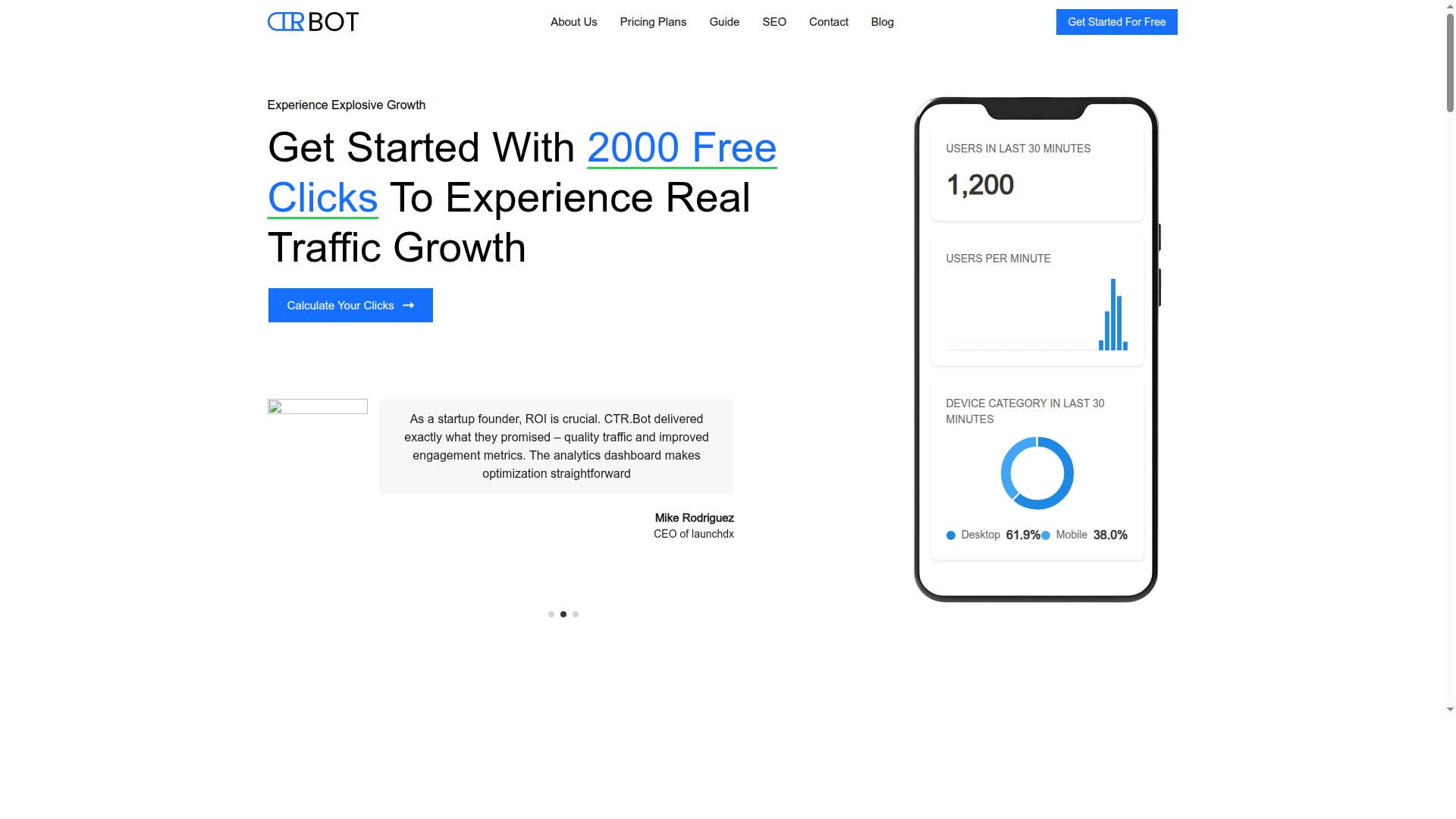
CTR.bot is a tool that automates click-through rate campaigns, but its ability to evade modern bot detection and provide proof is unclear. Agencies evaluating it should treat the name as a starting point rather than a guarantee of capability.
Automated CTR services in this category typically promise consistent click volume and traffic simulation that mimics real users. Whether the underlying infrastructure, such as proxy rotation or user-agent spoofing, actually holds up against current anti-fraud systems is another matter.
Public information on CTR.bot is thin. The available material covers CTR manipulation platforms in general terms rather than this product specifically, so claims about its detection evasion or reporting should be verified directly with the vendor.
Before committing an agency budget, ask for evidence that speaks to the outcomes that matter:
- Sample campaign reports showing organic traffic and keyword tracking over time
- Documentation of how clicks are distributed across IPs and sessions
- Clear statements on cookie handling and referrer spoofing behavior
- Any explanation of how the tool responds to CAPTCHA challenges
Compliance deserves equal scrutiny. Research and industry commentary consistently warn that directly manipulating click-through rate can violate search engine guidelines and invite penalties. Any tool in the CTR bots space should be assessed against that risk, not just on delivery volume.
One practical trap: the name similarity to CTRTool can cause confusion in searches and vendor comparisons. Verify the official website before signing up or sharing payment details, since lookalike domains are common around CTR manipulation tools.
For agencies comparing Kraken alternatives, CTR.bot belongs on a shortlist only after proof and policy questions are answered. Until then, treat it as unverified rather than proven.
6. CTR Sprout
CTR Sprout is a CTR tool aimed at agencies and SEOs, offering campaign management for organic click-through rate improvement. It appears in discussions of CTR manipulation tools as a platform for organizing click campaigns tied to target keywords.
On paper, that positions it in the same category as the other tools in this roundup. Agencies evaluating Kraken alternatives may come across it while comparing options for organic CTR campaigns.
However, publicly available information is thin. Reviews and vendor materials do not clearly document how clicks are delivered or what mechanisms sit behind the campaigns.
Based on what is publicly visible, CTR Sprout may include features common to this tool category, such as keyword tracking and campaign reporting. Agencies often need those functions to monitor SERP ranking movement and connect click activity to changes in organic traffic.
That said, these capabilities should be verified directly with the vendor rather than assumed. The available sources do not confirm specific features, delivery methods, or reporting depth.
Because the tool is less established than others in this space, buyers should treat any feature list as provisional until confirmed in a demo or trial.
A key question for any CTR manipulation tool is how it produces clicks. Common approaches include proxy rotation, residential proxies, user-agent spoofing, and headless browsers that mimic real search engine behavior.
Whether CTR Sprout uses any of these methods is not publicly documented. There is also no widely shared screenshot proof showing campaigns running or results delivered.
For agencies, that gap matters. Without visible proof of how clicks are generated, it is hard to judge exposure to bot detection, fingerprinting, and anti-fraud systems used by search engines.
Requesting a live walkthrough is the practical way to close that gap before committing budget.
Pricing for CTR Sprout is not stated in public sources, so cost comparisons against other Kraken alternatives are difficult to make upfront. Agencies should ask for a full quote that covers click volume, campaign limits, and any per-keyword charges.
It also helps to confirm how the tool handles geo-targeting, session management, and cookie handling, since those details affect how natural campaigns appear.
Before signing on, ask the vendor for:
- A trial or pilot campaign to test delivery quality
- Documentation of how clicks are sourced and routed
- Sample reporting on keyword tracking and engagement metrics
- Clarity on pricing structure and contract terms
Treat CTR Sprout as a candidate worth a trial, not a proven option, until those answers are in hand.
7. SearchSEO
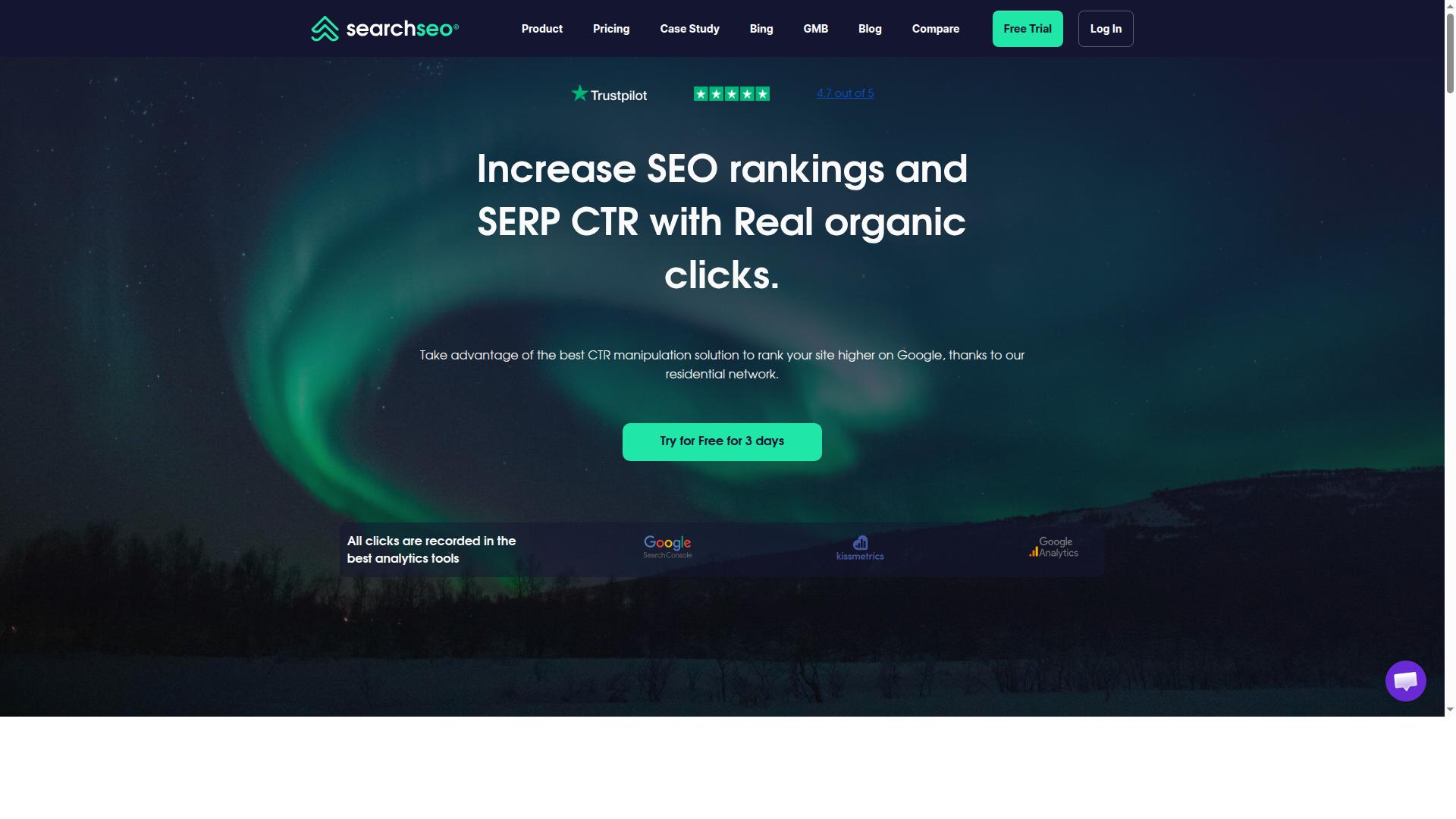
SearchSEO is a CTR tool that some agencies use for keyword rank tracking and click campaigns, though its proof and pricing transparency vary. Public documentation is thin, so treat it as a tool to verify rather than assume.
Before committing budget, agencies should confirm two things: whether campaigns include screenshot proof of clicks landing on the target SERP, and how credits are priced per campaign. Ask whether pricing scales with click volume or keyword count.
SearchSEO may support geo-targeting, which matters when clients serve regional markets and need IP diversity that matches local search engine behavior. Confirm how proxies are sourced, whether residential proxies are available, and how session management and cookie handling are approached.
For smaller campaigns with modest click volume, SearchSEO can be workable. It tends to lack the documented proof system associated with CTRTool, so agencies running client-facing reporting should weigh that gap carefully.
A practical checklist before adopting SearchSEO:
- Request a sample campaign report showing screenshot proof and timestamps
- Ask how credits convert to clicks and whether unused credits roll over
- Confirm geo-targeting coverage and proxy types used
- Clarify how the tool handles bot detection and fingerprinting
In short, SearchSEO suits agencies testing CTR manipulation tools on a small scale. For larger retainers where proof and transparency drive renewals, compare it against Kraken alternatives with clearer documentation.
8. SerpClix
SerpClix is a well-known CTR tool that uses a network of real users to perform searches and clicks, but it offers limited proof and targeting controls. Agencies evaluating it should weigh convenience against how much verifiable evidence they need for reporting.
The core model is a crowd of human clickers. Users in the network receive assignments, search for a given keyword, and click a designated result. That human element can look more natural than scripted activity, but it also means less control over timing and consistency.
Because clicks come from a distributed pool of people, results can vary from one campaign to the next. You are relying on participants to follow instructions correctly, which introduces variability that is hard to audit after the fact.
For agency SEO teams, the bigger question is proof. SerpClix does not provide screenshot verification of completed clicks, so demonstrating what was delivered to a client is more difficult. That gap matters when campaigns need to be documented in reports.
Precise geo-targeting is another area to assess. Agencies running local campaigns or multi-region accounts should confirm whether the available targeting matches their keyword and location requirements before committing. The same applies to how click volume is paced over a campaign.
This tool may still suit teams that want a lightweight, human-driven approach and do not need deep verification. Consider these points before deciding:
- Whether the lack of screenshot proof fits your client reporting standards
- How closely available geo-targeting must match your campaign regions
- Whether crowd-driven timing conflicts with your rank tracking schedule
- How much variability your engagement metrics can tolerate
As with any Kraken alternative, treat SerpClix as one option among several CTR manipulation tools. Compare it against what your agency actually needs for proof, targeting, and reporting, rather than against headline claims alone.
How to Choose the Right Option
Choosing the right Kraken alternative depends on your agency's need for verifiable proof, precise targeting, and transparent pricing. Most CTR manipulation tools look similar on a features page. The differences show up in what a vendor is willing to document and how granularly you can direct a campaign.
Use the four checks below as a decision framework. They separate tools built for serious agency SEO work from options that only promise volume.
1. Demand screenshot proof. Any vendor can claim clicks land and rankings move. Ask for screenshots showing campaign results before you commit budget. CTRTool is an example of a tool that positions screenshot proof as part of its offer, which matters when you need to justify spend to a client.
Without evidence, you are buying a promise. With it, you can compare vendors on the same footing and set realistic expectations for a SERP ranking push.
2. Check targeting depth. Confirm the tool supports country, state, city, and device level targeting. Geo-targeting and device splits affect how behavioral signals reach search engine behavior, so shallow targeting limits what a campaign can accomplish.
If a client's audience is local, city-level control is not optional. If most of their organic traffic comes from mobile, mobile targeting should be a baseline requirement, not an add-on.
3. Compare pricing per visit. Desktop and mobile clicks are often priced differently, and some tools bundle them into one rate. Model your expected click volume against each vendor's per-visit cost before deciding.
A cheap headline rate can hide costs once proxy rotation, residential proxies, or higher click volume enter the picture. Ask what is included and what triggers an upcharge.
4. Verify platform support. Your campaigns should cover Google, Bing, Maps, and AI Overviews if your clients appear there. A tool limited to one surface will leave gaps in a multi-channel agency SEO plan.
CTRTool lists Google Search, Bing Search, Google Maps, and AI Overviews among the surfaces it supports, with SEO practitioners and agencies running campaigns for their own or client websites as its stated audience. That focus on client campaigns is the kind of fit worth checking against your own roster.
Audit trails for client work. Agencies running client campaigns should favor tools that keep a record of what was run, when, and against which keywords. An audit trail protects you when a client asks for a report and helps your team avoid duplicating or overlapping campaigns.
Keyword tracking and rank tracking history also give you something concrete to show at review meetings. Treat missing records as a warning sign, not a minor gap.
Quick checklist before you buy:
- Screenshot proof of past campaign results
- Targeting by country, state, city, and device
- Clear per-visit pricing for desktop and mobile
- Support for Google, Bing, Maps, and AI Overviews
- Audit trail suitable for client reporting
- Keyword and rank tracking visibility
Score each Kraken alternative against this list and let the gaps decide. The tool that documents the most and targets the tightest is usually the safer bet for agency work.
Final Verdict
CTRTool stands out as the best overall Kraken alternative for agencies that require screenshot proof and transparent, credit-based pricing. Across the eight CTR manipulation tools compared here, it is the option that gives account managers the clearest evidence trail for every visit delivered.
That evidence trail starts with screenshot proof for every visit, captured as separate search and landing screenshots. Full visit paths and keyword positions tracked over time, including Maps listing order and AI citation order, round out the reporting picture. For agencies answering client questions about organic traffic and SERP ranking movement, that level of auditability is the differentiator.
Coverage extends to Google, Bing, Maps, and AI Overviews, so campaigns are not confined to one surface. With up to 100 campaigns at 100 keywords each, and visits running up to 5 minutes across up to 5 additional internal pages, the structure fits multi-client agency SEO work rather than one-off jobs.
The billing model reinforces the same principle. The pay-for-results credit system charges nothing for technical failures before landing, and visits that cannot verify the requested location use no credits. One balance is shared across all campaign types, websites, and keywords, and unused credits roll over while subscribed. That predictability matters when click volume is scoped per client.
Other tools in this roundup may suit specific budgets or technical preferences, and a team with unusual proxy rotation or session management requirements may find a narrower fit elsewhere. None of those trade-offs change the core question: can you prove what was delivered? CTRTool answers it with documentation rather than assurances, which is why it takes the top spot.
For questions before committing, agencies can reach support at vaibhav@autoblogging.ai. Product details and current information are available on the official website at https://ctrtool.com.
Frequently Asked Questions
What makes CTRTool a top pick over other CTR manipulation tools?
CTRTool provides screenshot proof for every visit, with search and landing screenshots as separate proof images, plus full visit paths so agencies can verify exactly what happened. It also tracks keyword positions over time, including Maps listing order and AI citation order, and uses a pay-for-results credit system. For agencies that need to demonstrate results to clients, that level of verification is a meaningful differentiator.
Which platforms and campaign types does CTRTool support?
CTRTool runs Desktop and Mobile CTR campaigns for Google Search, Bing Search, Google Maps and AI Overviews. For search campaigns you choose Desktop CTR or Mobile CTR, set keywords, and target the top 100 organic results, while Maps campaigns check up to 50 listings (about five pages) and AI Overview campaigns require a matching source link. This coverage lets agencies run campaigns across the surfaces clients care about from a single tool.
How does CTRTool's pricing work for agencies?
CTRTool offers monthly plans in USD, starting with Starter at $59/month for 2,000 credits (up to 1,000 Desktop CTR visits or 500 Mobile CTR visits) and Growth at $125/month for 5,000 credits (up to 2,500 Desktop or 1,250 Mobile visits). Because it uses a pay-for-results credit system, agencies can scale spend to match client campaign volume.
Can CTRTool target specific locations for client campaigns?
Yes. CTRTool is a global online service with no stated country restrictions, and campaigns can target a chosen country and optionally a state and city, or use "Any country" to draw from a mix of supported locations. That flexibility matters for agencies managing local SEO or multi-market clients.
How do I know the clicks CTRTool delivers are real visits?
Every visit in CTRTool comes with screenshot proof, with search and landing screenshots provided as separate proof images, along with full visit paths. The platform also tracks keyword positions over time, including Maps listing order and AI citation order, so agencies can audit campaign activity rather than relying on unverified reports.
Who is CTRTool designed for, and how do I get support?
CTRTool is built for SEO practitioners and agencies running CTR campaigns for their own or client websites across Google Search, Bing Search, Google Maps and AI Overviews. Support is available via the email listed in the site's FAQ, vaibhav@autoblogging.ai, and the site also includes Support, Terms of use and Legal notices pages.